Most UCaaS providers understand the benefits of simplification.
Reducing operational complexity, improving efficiency, streamlining automation, and creating a more scalable operating model all sound like obvious advantages.
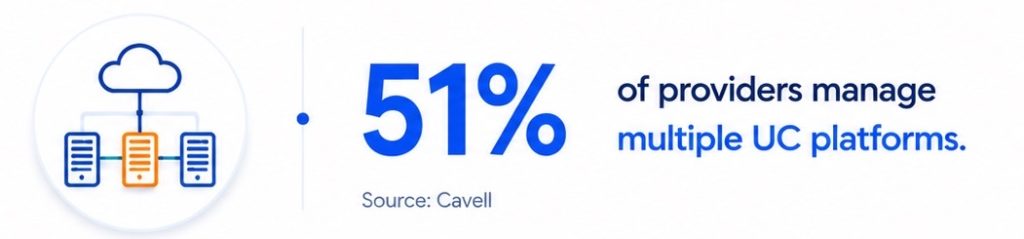
Yet many providers still struggle to consolidate fragmented platform environments.
Why?
Because consolidation is rarely just a technical project.
It impacts customers, operations, workflows, support processes, internal teams, and long term business strategy.
And while most providers recognize the growing cost of fragmentation, many hesitate to act because the barriers feel difficult to overcome.
The reality is that consolidation challenges are common—and manageable with the right approach.
Here are six of the biggest barriers providers face when simplifying UC platform environments and how leading organizations are addressing them.
1. Fear of Customer Disruption
One of the biggest reasons providers delay consolidation is concern about customer impact.
Customers may already be deeply embedded within existing workflows, devices, integrations, and user experiences tied to a specific platform.
Providers often worry that migration efforts could create:
- service interruptions
- support escalations
- customer dissatisfaction
- churn risk
As a result, fragmentation continues because maintaining the status quo feels safer.
How Providers Overcome It
Successful providers treat consolidation as a phased transition—not a sudden migration event.
That often includes:
- gradual migration strategies
- customer segmentation plans
- clear communication timelines
- migration support resources
- prioritizing low risk environments first
The goal is to reduce disruption while steadily simplifying the broader operating environment over time.
2. Operational Dependencies Built Over Time
The longer fragmented systems remain in place, the more embedded they become.
Internal teams often build workflows, integrations, and operational processes around existing platforms.
Over time, those workarounds become normalized.
This creates a situation where consolidation feels operationally risky because so many business functions are connected to existing systems.
How Providers Overcome It
Leading providers begin by mapping operational dependencies before making major consolidation decisions.
That includes evaluating:
- provisioning workflows
- support processes
- integrations
- automation tools
- billing environments
- internal operational handoffs
Understanding where fragmentation exists makes it easier to prioritize simplification efforts strategically instead of trying to change everything at once.
3. Concern About Losing Feature Flexibility
Some providers worry that consolidation could reduce flexibility for certain customers or use cases.
Different platforms may have historically been introduced to solve:
- niche feature requirements
- regional demands
- legacy customer needs
- vertical market customization
This can create the perception that simplifying platforms means limiting capabilities.
How Providers Overcome It
The most successful providers focus on long term operational scalability rather than preserving every isolated exception.
Instead of asking:
“Can one platform replicate every feature perfectly?”
They ask:
“Can a unified operating model support the business more effectively at scale?”
In many cases, operational simplicity creates greater long term value than maintaining fragmented feature sets indefinitely.
4. Internal Resistance to Change
Consolidation initiatives often require operational and organizational change.
Teams may already feel comfortable with existing systems, workflows, and responsibilities.
That can create resistance around:
- retraining
- process changes
- workflow standardization
- platform transitions
In fragmented environments, certain employees may also become deeply tied to specific platforms or systems.
How Providers Overcome It
Organizations that navigate consolidation successfully typically position simplification as a business growth initiative—not just an IT project.
That means communicating:
- operational benefits
- scalability improvements
- automation opportunities
- reduced inefficiency
- long term strategic value
When teams understand how simplification improves the broader business, resistance often becomes easier to manage.
5. Migration Complexity
Some providers avoid consolidation because the migration process itself feels overwhelming.
The larger and more fragmented the environment becomes, the more difficult it can seem to untangle:
- customer environments
- integrations
- workflows
- operational dependencies
- legacy systems
This often creates a “we’ll deal with it later” mindset.
Unfortunately, waiting usually makes the problem harder to solve.
How Providers Overcome It
Providers that simplify successfully rarely attempt large scale transformations all at once.
Instead, they:
- prioritize high impact areas first
- simplify incrementally
- consolidate in phases
- create repeatable migration processes
- standardize future deployments early
Progressive simplification is often more sustainable than attempting complete transformation immediately.
6. Short Term Thinking
Fragmented environments can continue functioning for years.
Because the operational impact compounds gradually, providers sometimes underestimate the long-term cost of complexity.
The immediate pain may not feel urgent enough to justify change.
But over time, fragmentation often leads to:
- reduced agility
- slower automation
- higher operational costs
- inefficient scaling
- tighter margins
The cost of waiting compounds quietly.
How Providers Overcome It
Forward looking providers evaluate consolidation through a long-term operational lens.
They recognize that:
- operational efficiency compounds over time
- scalable systems create long term leverage
- automation depends on simplification
- connected ecosystems support innovation
Consolidation becomes easier—and more valuable—the earlier providers begin simplifying fragmented environments.
Simplification Is a Strategic Advantage
The barriers to consolidation are real.
But so are the long term costs of fragmentation.
As the UCaaS market evolves, providers are facing increasing pressure to:
- operate efficiently
- automate workflows
- support AI initiatives
- scale profitably
- deliver connected customer experiences
Fragmented environments make all of those goals harder to achieve.
That’s why more providers are reevaluating how platform strategy impacts operational scalability and long term business performance.
Consolidation is no longer just about reducing tools.
It’s about creating a simpler, more scalable foundation for future growth.
Explore the Full Cavell Research
Want deeper insight into the operational trends driving platform consolidation across the UCaaS market?
Download the Cavell report to explore the research, market data, and strategies shaping the future of scalable cloud communications.