
TL;DR
The telecom industry is entering a new growth phase driven by AI, digital infrastructure, and platform-based services. According to McKinsey & Company, telcos that succeed will focus on four strategic priorities:
- Building AI-native operations and customer experiences
- Expanding beyond connectivity into new revenue streams
- Modernizing infrastructure for AI and enterprise demand
- Reshaping business structures to improve scale and profitability
Telcos that move early can become digital ecosystem leaders instead of commodity connectivity providers.
Table of Contents
- Why are telcos moving toward AI-native transformation?
- Why do telcos need growth beyond connectivity?
- How is infrastructure becoming a competitive advantage?
- Why are telcos restructuring their business models?
- How does CAIRO by NetSapiens support the next phase of telco growth?
- What does the future of telecom look like?
Why are telcos moving toward AI-native transformation?
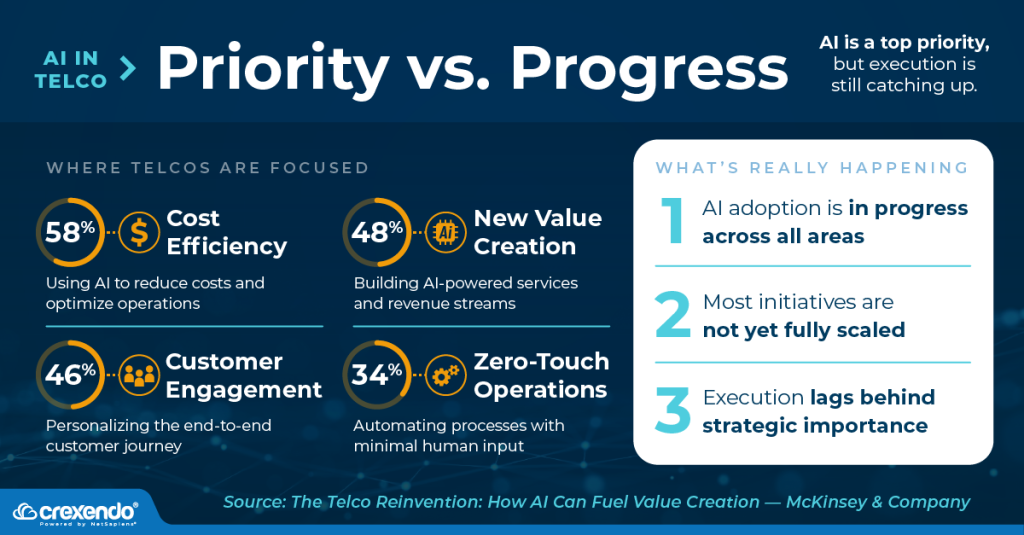
Telcos are no longer treating AI as a small pilot project. The industry is moving toward AI-native operations where AI is built into core business processes.
According to McKinsey & Company, many telecom companies still struggle to generate measurable returns from AI because projects remain isolated across departments.
Key areas where AI creates value
| AI Focus Area | Business Impact |
|---|---|
| AI-driven automation | Reduces operational costs |
| Zero-touch operations | Enables self-healing networks and fewer manual tasks |
| AI-powered customer management | Improves retention and personalization |
| AI-enabled products | Creates differentiated services |
What telcos need to succeed with AI
Telcos need two foundational capabilities:
- A unified data platform that removes data silos
- A cross-functional operating model that supports rapid experimentation and scaling
Without these foundations, AI investments often fail to scale across the organization.
Why do telcos need growth beyond connectivity?
Traditional telecom services are becoming commoditized. Mobile data and voice services alone are no longer enough to sustain long-term growth.
Telcos are now expanding into adjacent digital services using assets they already own:
- Customer trust
- Large-scale network infrastructure
- Subscriber and network data
- Billing relationships
New revenue opportunities for telcos
| Growth Area | Opportunity |
|---|---|
| Fintech and digital services | Bundled ecosystem offerings |
| B2B ICT services | Cloud, cybersecurity, and managed IT |
| Network APIs | Monetizing 5G capabilities for developers |
| Private 5G networks | Enterprise connectivity for manufacturing and logistics |
Why these matters
This shift moves telcos from a product-based business model to an ecosystem-based business model. Instead of selling only connectivity, telecom providers can deliver integrated digital services across industries.
How is infrastructure becoming a competitive advantage?
Infrastructure is becoming one of the most important strategic assets in telecom.
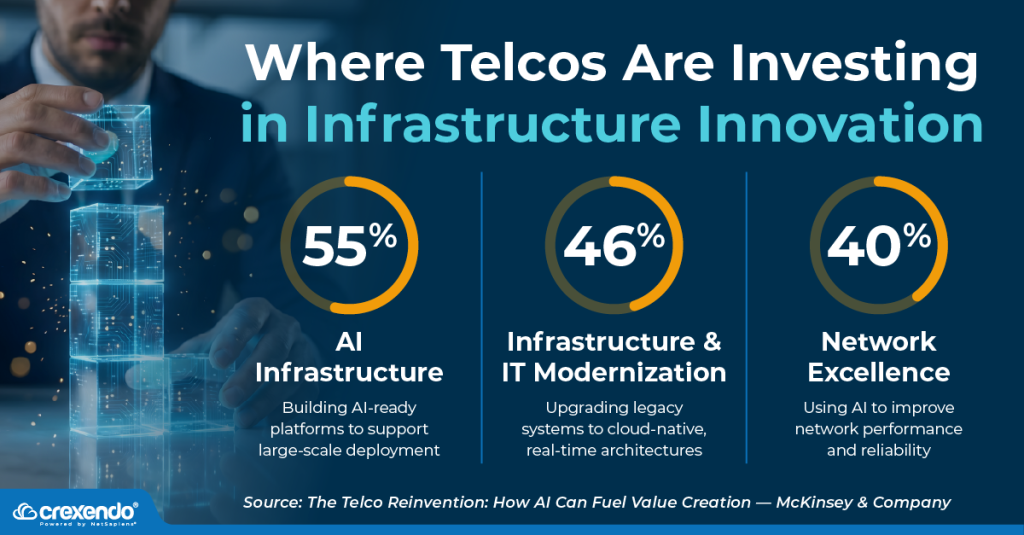
AI workloads, edge computing, and enterprise cloud demand are increasing the need for secure and localized infrastructure.
The three major infrastructure priorities
| Infrastructure Focus | Strategic Benefit |
|---|---|
| AI infrastructure | Supports sovereign and secure AI workloads |
| AI-optimized networks | Improves resilience, automation, and efficiency |
| Cloud-native IT systems | Increases agility and scalability |
Why telcos have an advantage
Telcos already own critical infrastructure and operate within local regulatory environments. This gives telecom providers an advantage in areas such as:
- Data sovereignty
- Secure connectivity
- Local market presence
- Trusted infrastructure operations
However, legacy systems remain a challenge. Many telecom companies still rely on outdated IT and network architectures that limit speed and flexibility.
Why are telcos restructuring their business models?
Many telecom markets still face low returns, high infrastructure costs, and intense competition.
To improve profitability, telcos are redesigning how their businesses are structured.
Two major restructuring strategies
| Strategy | Goal |
|---|---|
| NetCo/ServCo separation | Separates infrastructure and service operations |
| Strategic mergers and acquisitions | Increases scale and reduces costs |
What is a NetCo/ServCo model?
A NetCo (Network Company) manages telecom infrastructure, while a ServCo (Service Company) focuses on customer-facing products and services.
This structure helps telecom companies:
- Improve operational focus
- Unlock asset value
- Accelerate specialization
- Increase investor clarity
Large-scale restructuring can be difficult, but it may significantly improve long-term financial performance.
How does CAIRO by NetSapiens support the next phase of telco growth?
CAIRO for NetSapiens is an AI-powered platform designed to help service providers modernize customer engagement, automate operations, and deliver new AI-enabled services.
As telcos and service providers move toward AI-native operations, platforms like CAIRO help bridge the gap between communications infrastructure and AI-driven business execution.
What is CAIRO?
CAIRO is an AI platform from NetSapiens that combines conversational AI, automation, analytics, and communications workflows into a unified environment.
CAIRO helps providers:
- Automate customer interactions
- Deliver AI-powered voice experiences
- Analyze conversations in real time
- Trigger workflows automatically
- Improve operational efficiency
How CAIRO aligns with the four telco growth bets
| Telco Growth Area | How CAIRO Supports ItGoal |
|---|---|
| AI-native transformation | Automates workflows and customer engagement |
| Growth beyond connectivity | Enables AI-powered services and customer experiences |
| Infrastructure innovation | Integrates AI into communication platforms and workflows |
| Market differentiation | Helps providers deliver smarter and more personalized services |
Why this matters for service providers
Many providers already have strong communications infrastructure but lack scalable AI capabilities. CAIRO helps service providers add AI-driven automation and customer experience tools without replacing their existing telecom environment.
This allows providers to move beyond traditional UCaaS and voice services toward higher-value AI-enabled offerings.
The bigger opportunity
The future of telecom is increasingly tied to AI-powered interactions. Voice is evolving from a communication channel into an intelligent execution layer that can:
- Understand customer intent
- Automate business processes
- Deliver real-time insights
- Improve customer outcomes
Platforms like CAIRO by NetSapiens help service providers participate in this shift by combining communications, automation, and AI into a single platform experience.
What does the future of telecom look like?
The telecom industry is evolving from a connectivity utility into a digital platform business.
The four strategic bets identified by McKinsey & Company are deeply connected:
- AI transformation improves efficiency and customer engagement
- New revenue models depend on platforms, APIs, and ecosystem services
- Infrastructure modernization supports enterprise and AI growth
- Market restructuring improves scale and execution
The bigger shift
Future telecom leaders will not compete only on coverage or pricing. They will compete on:
- AI capabilities
- Digital ecosystems
- Enterprise services
- Platform infrastructure
- Customer experience
Telcos that modernize early can become central players in the digital economy. Those that delay risk becoming low-margin connectivity providers in an increasingly standardized market.
Author
-
 View all posts
I’m a product marketing professional with over 15 years of experience in communications technology and SaaS. I focus on voice technologies, particularly AI, and how they’re transforming customer engagement and business outcomes.


